
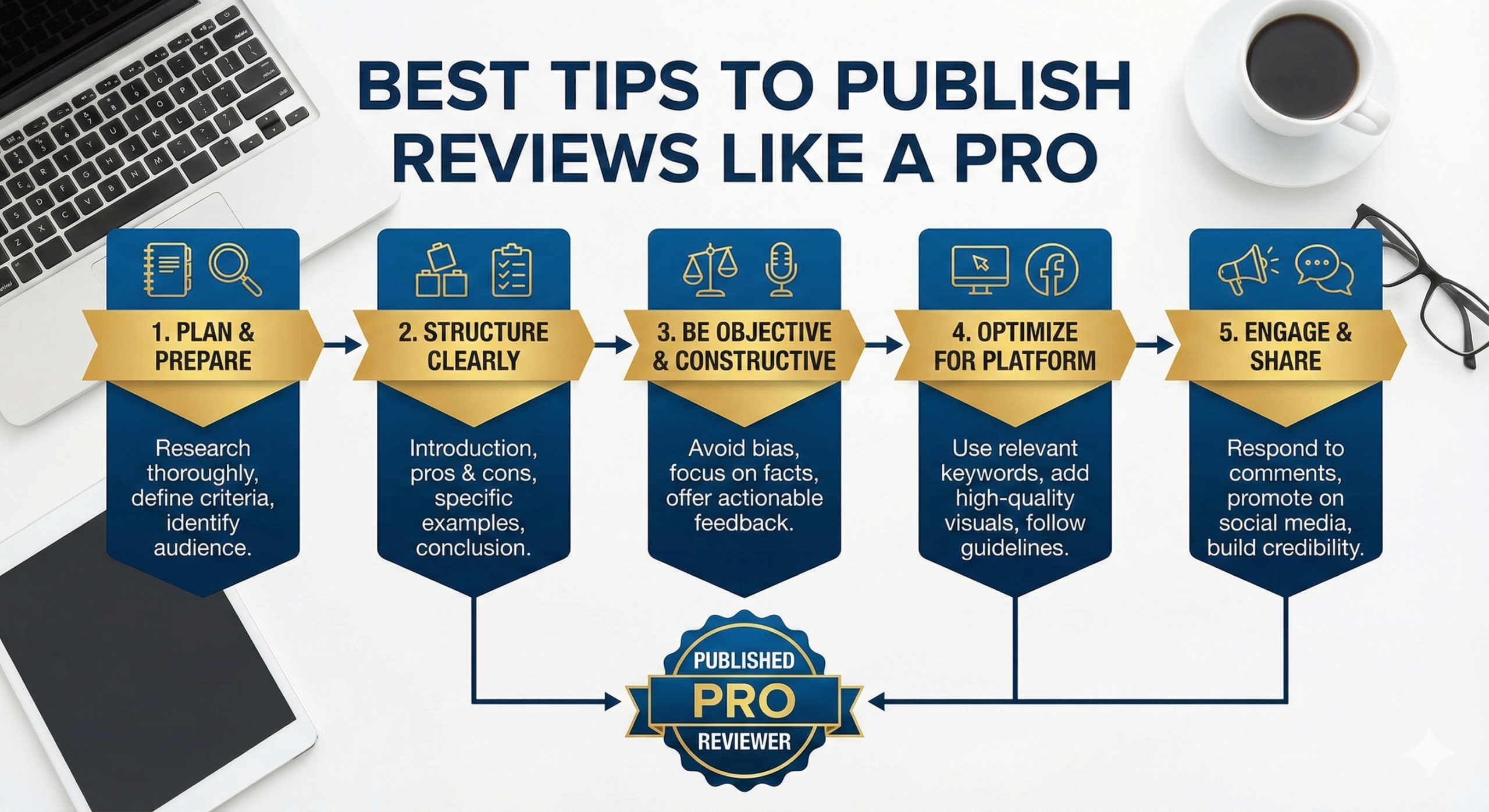
Today, sharing reviews is much more than simply posting your view online. A digital, professionally crafted review can have significant effects, such as impacting potential consumers, establishing confidence in the company, and increasing search visibility. Publishing a review professionally is the key in order to avoid it being overlooked and instead, make it impactful. This can be in the form of reviews regarding a product, service, software, or experience.
In the following, publishing reviews with professionalism and authenticity, designed to be readable, credible, and captivating will be shown.
Get to the Bottom of the Purpose Behind the Review
Prior to writing a review there must be a purpose to the review, and a clear purpose must be accompanied by it. A review that has a clear purpose will be professional. For example, it may assist in the potential consumers decision, describing pros and cons in honest fashion, or it may try to align expectations with performance.
When your purpose is well-defined it will allow for a much more focused tone, and your content will feel more structured and organized, and move away from feeling promotional or scattered. A review written with the intent of lending a helping hand is much more appreciated, and users can determine this when the review is purposefully written to assist the reader instead of being a filler.
Understand your desired demographic
Your review should engage a specific audience. Reviews aimed at new customers differ considerably from those aimed at repeat customers. Consider the readership of your review and what they wish to find out.
Your audience determines:
- The level of complexity in the terminology
- The specific features that should be highlighted
- The issues that are of greatest importance to your audience
- The greater the alignment of your review meets the audience’s expectations, the greater the level of credibility your review will possess.
Provide an honest and concise introduction
The introduction is the most important part of the review. Context and importance to the review should be established in the introduction. The beginning should be neutral and not contain excessive praise or unbalance negativity.
For transparency’s sake and to maintain the attention of the audience, the introduction should include:
A description of the product or service
The intended consumer of the product or service
A short summary of your experience with the product or service.
Assumptions should be avoided at all costs
The most significant error encountered when crafting a review is assuming or misrepresenting a product. Professional reviews are built on experience. More than detailed, unoriginal content, readers are looking for authentic insight.
Explain how the product or service operated in real-world situations, including such factors as usability, performance, durability, support, or results based on actual performance. Specific details lend authenticity and help your review stand out.
Organize the reviews for a better reading experience
A systematic review presents well and affords ease of consumption by reviewers. A review writer should avoid long contiguous blocks of texts and division of text blocks into subsections/separate headings. This will help the reviewers avoid overflow of information and help them maintain their engagement. The writer should utilize formatting and spacing features such as shorter text blocks of paragraphs instead of long blocks and the inclusion of blank lines to aid the reviewers in discernibly separating the ideas.
Basic examples of such a structure include:
- A Summary
- Major characteristics and or distinctive features
- Advantages and Disadvantages
- Performance or Outcomes
- Overall Conclusion
This sort of structure help your audience find the details they are looking for right away.
Be honest and fair
Trust is the basis of a good review. A review meant to be professional does not act as though everything is perfect. Being honest and straightforward helps build trust, especially if they include both good and bad features.
Negatively influenced reviews are, however, inevitable. When mentioning these criticisms, do so in a way that helps the reader build trust to see how genuine your review is. Fairness helps reviews perform a lot better than marketing hype.
Be straightforward and avoid a complex structure
Just because the review is meant to be professional does not mean the language has to be complicated or, really, anything beyond the basics. Use precise language that helps deliver your message and speaks to a wider audience base.
In order to actively engage an audience, a writer must keep a steady pace, and this can be done with shorter sentences, active voice, and a smooth, flowing writing style. Many times, an essay of this kind requires an informative and conversational style.
EXPLAIN, DON’T JUST LIST.
You explain how a product you use works and how it stacks up against a review of its competitors, and you tell your audience a lot. This illustrates how to get practical value from your reviews. For product reviews, you explain how a product works and what its competitors are.
A product review or service description helps to visualize a product or service with examples, including use cases or scenarios.
Optimize without going to extremes.
A review needs to keep a reader’s experience in mind. Explaining how a review is optimized for search is important, but if a review keyword is overused, it harms its readability and trust.
When writing, you should focus on how to make it sound natural and how to use intent-based writing. If your content provides value and truly answers questions users may have, you will be rewarded by search engines.
Finish with a strong and encouraging conclusion.
Your conclusion should present a summary of your findings that aids your reader in making a decision. You finish in a collegial and professional manner by helping the reader without presenting too much pressure.
You can summarize all of the following questions:
– Who is the target audience for this product/service?
– Who would benefit from the competition?
– Does this product/service provide value for what it costs or claims?
– Does the conclusion summarize the points, providing a logical finality, or is it just a summary?
Make it crystal clear how to proceed with the information provided, to ensure your review’s full potential is reached.
Review, and edit the work to ensure it is free from error.
Never review the work without making corrections and ensuring the work is of good standard. Poor expressions, spelling, and grammatical errors quickly drop the reputation of the review. To ensure the work is clear and logical, read the work to yourself.
Professional and published work includes ensuring all of the links within the work have the correct formatting and are valid.
Make sure to use a metaphoric ‘clean/home office’ to ensure a good reputation for your work, taking the presentation of your review seriously so that it reflects your knowledge and expertise.
Make sure to use a reputable platform to publish your own review.
Consider the value that your review will provide to your own potential audience. Professional and well-structured forums such as divdigitalonline.com excel at showcasing your work to potential website visitors.
Once published, a good review will maintain an audience for a long time.
Publishing a review requires work, purposeful intention, a clear structure and organization of a review, and all of this with full transparency. Genuine balanced experience and presentation provide the value the audience seeks. This helps your review to stand out.
If followed, the action provided through your reviews will get great respect and will be acted upon.